
Qveris
A pay-as-you-go capability routing network that connects AI agents to 10,000+ real-world APIs and data sources through a single protocol.
Are you the maker? Claim this listing to keep info, pricing and screenshots current. Verified via your tool's domain email.
QVeris is the clearest option for developers building AI agents that need structured, auditable access to financial data and external APIs without committing to a monthly subscription. Its pay-per-call credit model is genuinely different from subscription-gated competitors, but the platform is early-stage with thin public user sentiment and no visible third-party reviews to validate its reliability claims. Teams that need a mature, battle-tested agent tooling layer with a large community should look at Composio or similar established players instead.
What is Qveris?
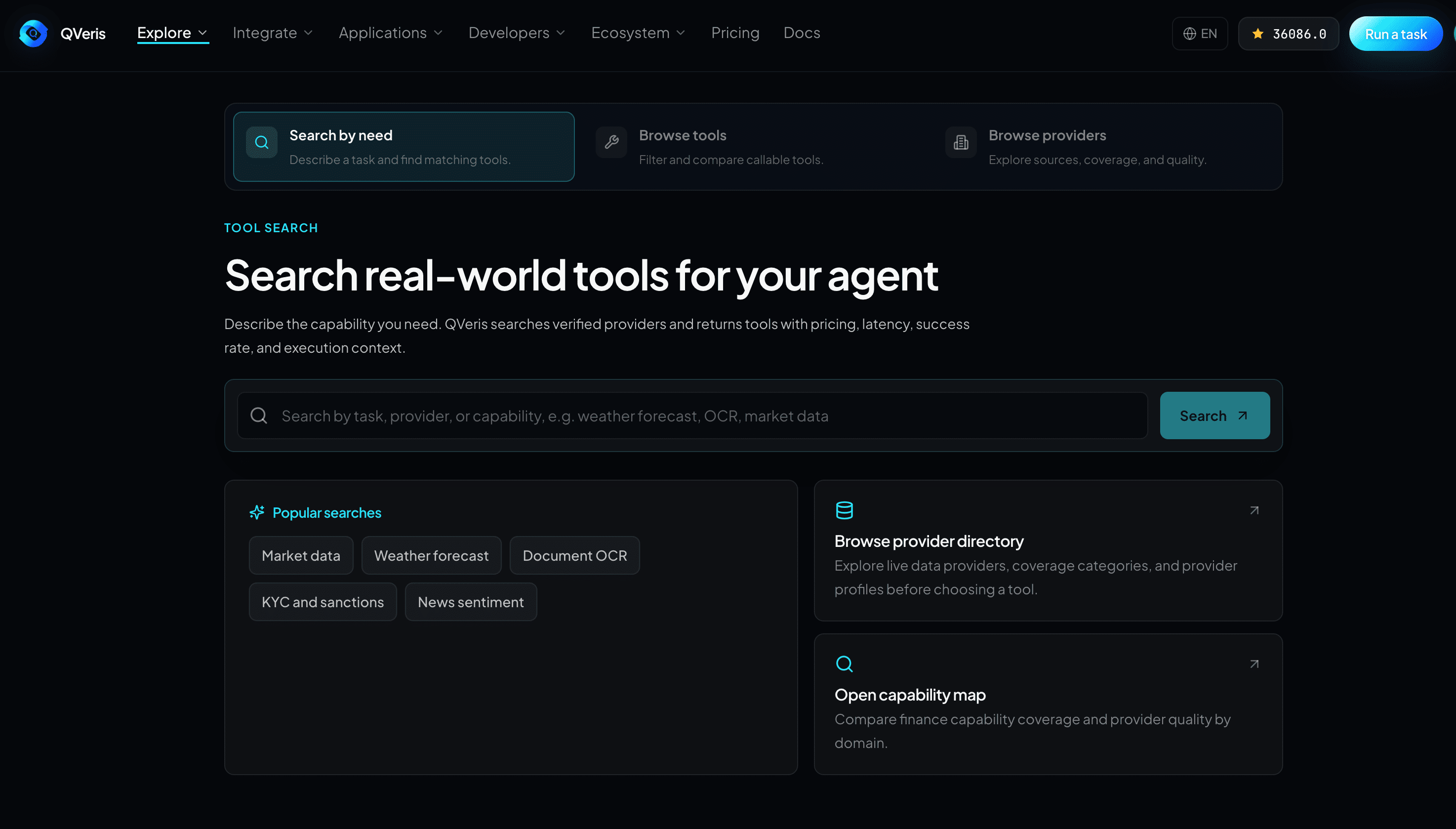
QVeris is a capability routing network that gives AI agents structured access to over 10,000 real-world APIs, live data sources, and external services through a unified protocol. Developers integrate via a CLI, Python SDK, JavaScript SDK, MCP server, or REST API. The platform follows a Discover-Inspect-Call model: agents search the capability catalog in natural language, review parameter schemas and estimated credit costs, then execute calls that return structured JSON output with a full audit trail.
The platform has a particular depth in financial data, covering equities, fixed income, FX, crypto, macroeconomic indicators, and alternative signals across 138 documented finance capabilities. Pricing is pay-as-you-go with no monthly subscription: new accounts receive 1,000 free credits, and purchased credits never expire. QVeris targets individual developers and teams building production AI agents that need auditable, cost-predictable access to external tools and data.
How we scored Qveris
Capability scores 19 because the finance catalog depth (138 documented capabilities) and the Discover-Inspect-Call architecture are genuinely differentiated, but the platform is early-stage and the breadth claim of 10,000+ capabilities cannot be independently verified. Ease of use scores 17 because the CLI, SDK, and MCP server lower integration friction for developers, but the 10 req/min free-tier rate limit and absence of a visual no-code interface add friction for non-developer evaluators. Value scores 20 because the pay-per-call model with non-expiring credits and a $19 entry point is structurally fair, and the Scale tier's volume bonuses (up to 15% at $1,000) reward heavier users without locking them into subscriptions. Delivery scores 12 because no independent third-party reviews exist to validate the platform's production reliability claims, all published comparisons carry a conflict-of-interest disclosure from QVeris itself, and the platform appears to be in early commercial operation with limited public track record.
Pros and cons
What we liked
- Pay-per-call credit model with no monthly subscription and credits that never expire, which is structurally cheaper than subscription-gated competitors for intermittent or bursty agent workloads.
- 138 documented finance-specific capabilities covering equities, fixed income, crypto, macro indicators, and alternative signals, making it the most finance-focused option in this category.
- CLI runs as a subprocess outside the LLM context, claiming up to 80% fewer prompt tokens versus a standard MCP setup, with an open-source toolkit on GitHub that is fully inspectable.
Where it falls short
- No independent third-party reviews, G2 listings, or Product Hunt entries found during research, making the platform's production reliability claims impossible to verify from outside sources.
- The comparison guides published on qveris.ai against Composio, Polygon, and Alpha Vantage carry an explicit conflict-of-interest disclosure since QVeris itself is the publisher, reducing their value as objective benchmarks.
- Rate limit on the free tier is capped at 10 requests per minute, and the Pro plan at 100 req/min may constrain high-throughput agent pipelines without moving to the Scale top-up tier, which has no published rate limit ceiling.
Key features
Qveris pricing
No monthly subscription. Free tier gives 1,000 signup credits. Pro plan is $19 for 10,000 credits with a $0.002/credit overage rate. Scale top-ups start at $1 with volume bonuses: $100 buys 52,500 credits (5% bonus), $500 buys 275,000 credits (10% bonus), $1,000 buys 575,000 credits (15% bonus). Credits never expire. Discover and Inspect actions are always free.
| Plan | Price | Who it is for |
|---|---|---|
| Free (Signup Credits) | $0 | 1,000 one-time trial credits after signup verification. 10 req/min rate limit. Basic tools access, community support, live demo access, standard queue. Discover and Inspect are always free on all tiers. |
| Pro | $19 | 10,000 credits. 100 req/min rate limit. All available tools, email support with 24-hour response, usage analytics, priority queue. Overage at $0.002 per credit. Credits never expire. |
| Scale (On-Demand Top-Up) | $1+ | Buy any amount. $100 gets 52,500 credits (5% bonus); $500 gets 275,000 credits (10% bonus); $1,000 gets 575,000 credits (15% bonus). Everything in Pro. No monthly commitment. Credits never expire. |
| Enterprise | Contact sales | Custom pricing, dedicated support, custom SLAs, and volume discounts. Enterprise VPC and private cloud options listed as planned. |
Pricing reflects what we saw at time of review (2026-09). Always confirm current pricing on the tool's own site.
Who should use Qveris?
A solo developer or small team building a financial research agent, a quant workflow, or a data-heavy automation pipeline will find QVeris's credit model and finance catalog genuinely useful. The pay-per-call structure means you are not paying for idle capacity, and the Inspect step lets you see the cost of a call before it runs, which is practical for keeping agent loops within budget. The CLI's reduced token overhead is a real advantage for anyone running many sequential agent steps against an LLM API.
If you need a platform with a large, active developer community, managed OAuth for SaaS app integrations, or a track record you can verify through independent reviews, QVeris is not ready for that role yet. Cursor is the stronger pick for developers whose primary need is AI-assisted code editing rather than external API routing. For broader agent tool connectivity with more established community support, Composio (not currently in this directory) is the most direct alternative, though teams should weigh QVeris's no-subscription model against Composio's tiered monthly plans depending on their call volume.
Skip it if: Teams that need a proven, community-validated platform with extensive third-party integrations and managed OAuth flows out of the box.
Qveris alternatives
Tags
Frequently asked questions
Do I need a credit card to start using QVeris?+
No. Signing up gives you 1,000 free credits after verification, enough to run basic capability calls and evaluate the platform. A card is only needed when you buy additional credits.
How much does a typical API call cost in credits?+
Simple data queries cost around 1 credit. OCR on a page costs about 2 credits. PDF parsing runs 3 to 10 credits. Financial report analysis costs 5 to 15 credits, and image generation costs 5 to 20 credits. Each capability shows its estimated cost during the Inspect step before you commit.
Is there a monthly subscription?+
No. QVeris uses pay-as-you-go pricing. The Pro plan is a one-time $19 purchase for 10,000 credits, not a recurring monthly charge. Credits never expire and there is no auto-renewal.
What rate limits apply?+
The free tier allows 10 requests per minute. The Pro plan raises that to 100 requests per minute. Scale top-up purchases inherit Pro limits; no higher published rate limit exists for self-serve plans.
Does QVeris work with any LLM or agent framework?+
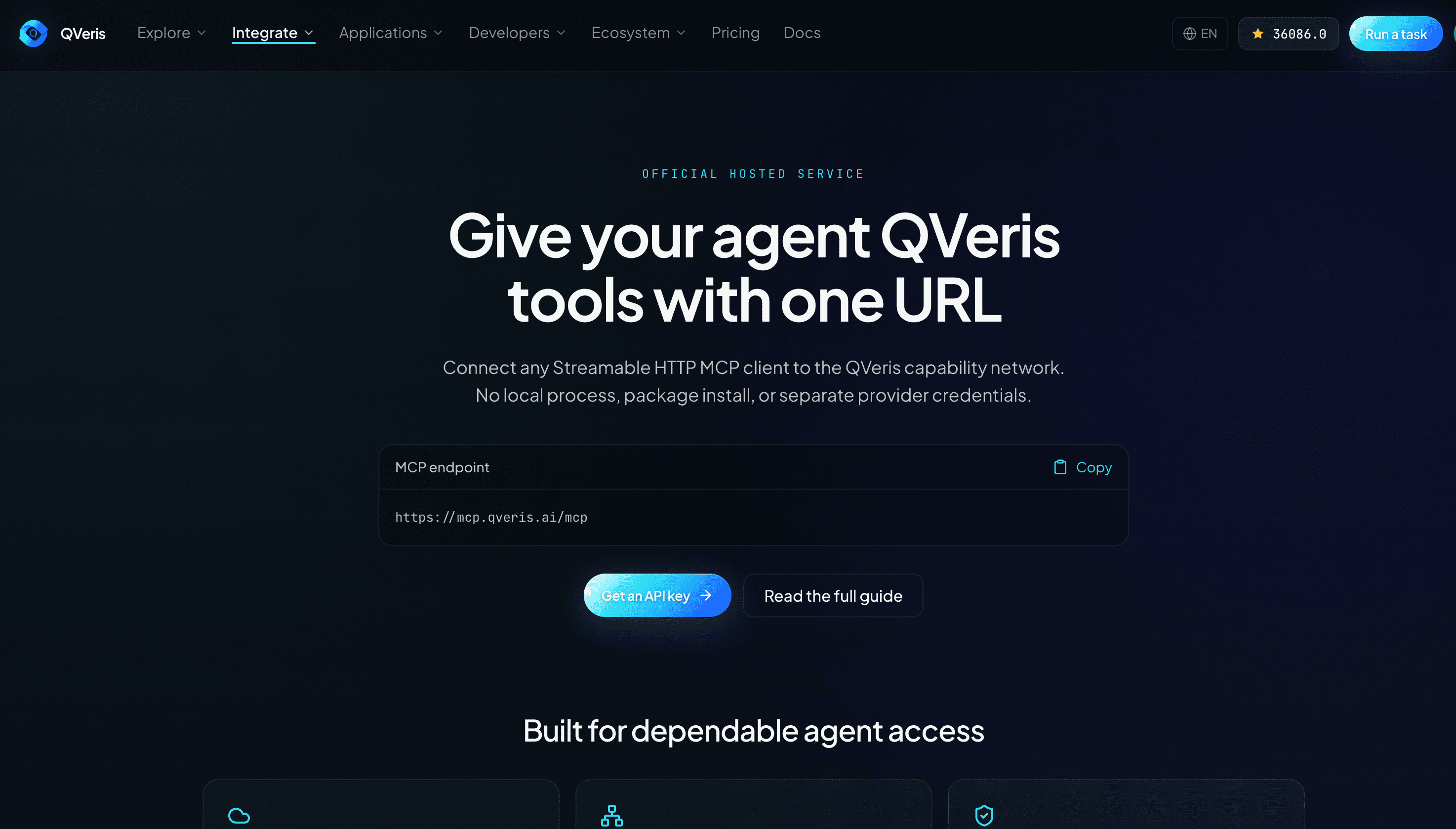
QVeris provides a CLI, Python SDK, JavaScript SDK, MCP server, and REST API, so it can integrate with most LLM frameworks. The MCP server specifically targets MCP-compatible agents. The CLI runs as a subprocess outside the LLM context.
Is the financial data catalog suitable for production trading systems?+
QVeris documents 138 finance capabilities covering live market prices, company financials, macro indicators, and on-chain data. The platform is positioned for research and analysis workflows. For regulated production trading, you should verify data licensing, SLA terms, and compliance requirements directly with QVeris sales before committing.
More AI Coding & Dev Tools
See all categoriesGet your tool listed on 300+ directories.
One listing here is a strong start. But the founders who get discovered everywhere are listed everywhere. Our sister site, Free AI Directories, submits your tool to 300+ AI directories for you, every single one by hand, by a real person.
It is a one-time payment of $49, no subscription, and you can follow along as the submissions land. Prefer the slow route? The same site keeps a free list of 450+ directories you can work through yourself.
Get my tool listed on 300+ directoriesOne-time payment, no subscription · 100% human submissions · Free list of 450+ directories included.