
SkaleAgents
MCP-connected control plane for AI DevOps agents: browse specialist bots, run infrastructure reviews.
Are you the maker? Claim this listing to keep info, pricing and screenshots current. Verified via your tool's domain email.
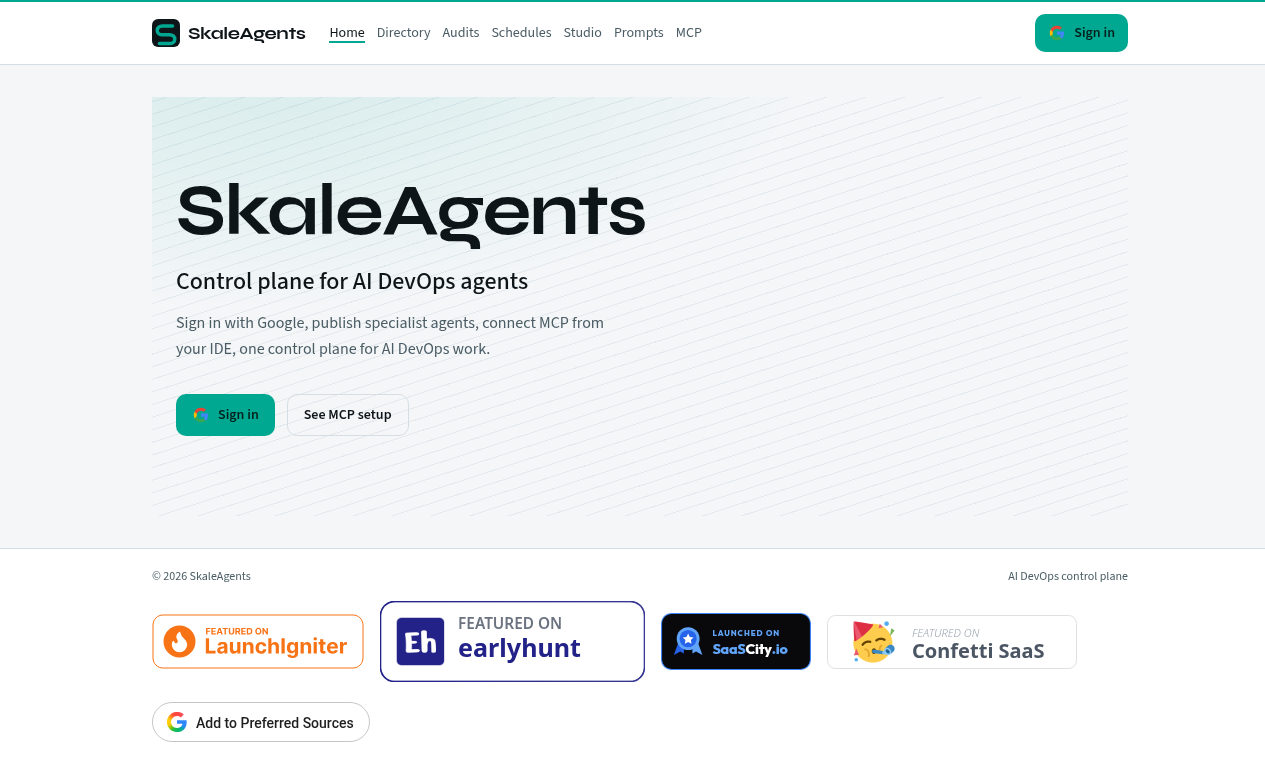
SkaleAgents suits individual engineers who want AI-assisted infrastructure and code reviews without leaving their editor, using MCP to wire specialist bots directly into Cursor, Claude Code, or ChatGPT. Its public bot directory and prompt library are genuinely useful starting points, but the platform is early-stage and lacks the governance, audit trails, and team-management features that Orkas or TRam Studio offer. Teams with compliance requirements or multi-user workflows should look elsewhere.
What is SkaleAgents?
SkaleAgents is a web-based platform that connects AI assistants to DevOps review workflows through the Model Context Protocol. Engineers add it as a hosted MCP server in clients like Cursor, Claude Code, Claude Desktop, or ChatGPT, then ask their assistant to run structured reviews of code and infrastructure. The platform provides a public directory of specialist bots covering security, reliability, MLOps, and performance, alongside a prompt library and a Creator Studio for building custom review bots.
Access requires only a Google OAuth sign-in to save work and connect tools; browsing public bots and the editable demo needs no account at all. Scheduled audits with webhook support allow recurring infrastructure checks. The tool targets individual engineers and small DevOps teams who want AI-assisted second opinions on Terraform, Kubernetes manifests, and similar infrastructure artifacts without switching out of their existing editor environment.
How we scored SkaleAgents
Capability scores 16 because the MCP integration and structured review output are genuinely useful ideas, but the bot directory has no visible quality signal, and the feature set is narrower than Orkas or TRam Studio on team workflows and audit history. Ease of use scores 18 because the no-account demo, Google OAuth onboarding, and in-editor MCP flow are all low-friction, though documentation depth is unclear. Value scores 15 because the tool is free, which is a real advantage, but the absence of any formal pricing, SLA, or commitment makes it hard to budget around for anything beyond personal use. Delivery scores 9 because there are zero independent user reviews, no documented uptime or reliability commitments, and no verifiable evidence that live review quality matches the polished illustrative examples on the homepage; the platform is too new and too opaque to score higher on delivery without external validation.
Pros and cons
What we liked
- MCP integration puts review findings directly inside the editor conversation, eliminating context-switching between tools.
- Public bot directory and prompt library are accessible without an account, making evaluation genuinely frictionless.
- Creator Studio lets engineers codify their own review process into a reusable, shareable bot rather than re-prompting from scratch each time.
Where it falls short
- No visible paid tier, SLA, or uptime commitment means there is no contractual basis for relying on this in a production pipeline.
- Scheduled audits and webhook support are listed as features, but the live page shows no documentation on limits, rate caps, or retention for audit job history, which is a specific gap versus Orkas and TRam Studio.
- The bot directory quality depends entirely on what specialists have published; there is no visible vetting, rating system, or quality signal to distinguish a well-tested bot from a placeholder.
Key features
Who should use SkaleAgents?
A solo backend engineer or DevOps practitioner who already uses Cursor or Claude Code and wants a structured second opinion on Terraform configs, Kubernetes manifests, or architecture decisions will get real value here. The MCP integration means findings land in the same conversation as the code, which is a meaningful workflow improvement over manually pasting context into a chat window. The free entry point and no-account browsing make it easy to evaluate before committing.
Anyone running a team that needs role-based access, shared audit history, compliance reporting, or enterprise SSO should look elsewhere. Orkas is a better fit for teams that want a local-first, open-source agent coordinator with a Commander-and-specialist model. TRam Studio is the right call for organizations on Azure that need built-in governance and auditability across multi-step workflows.
Skip it if: Teams needing governance, audit trails, or enterprise workflow controls
SkaleAgents alternatives
Tags
Frequently asked questions
Do I need an account to try SkaleAgents?+
No. Public bots, the prompt library, and the editable demo are all accessible without signing in. You only need a Google OAuth sign-in to save your own work, publish bots, or connect MCP to your editor.
Which editors and AI clients does SkaleAgents support via MCP?+
The site lists Cursor, Claude Code, Claude Desktop, ChatGPT, and Codex as supported MCP clients. You add SkaleAgents as a hosted MCP server URL in your client's configuration.
How much does SkaleAgents cost?+
No paid tiers or subscription prices were visible on the pricing page at review time. The platform appears to be free, but no formal pricing documentation or SLA was found. Verify current pricing directly on the site before relying on this for a team.
What kinds of infrastructure can SkaleAgents review?+
The platform's examples cover Terraform configurations, Kubernetes manifests, and general architecture. Specialist bots are organized around DevSecOps, SRE reliability, MLOps, and scaling and cost disciplines.
Can I build and publish my own specialist bot?+
Yes. The Creator Studio is designed for turning a custom review process into a reusable bot. Published bots can appear in the public directory, though no vetting or quality-rating system is currently visible.
Does SkaleAgents support recurring automated reviews?+
Yes, scheduled audits are listed as a feature, with optional webhook delivery of findings. Specific limits on schedule frequency, audit history retention, or webhook payload format are not documented on the public site.
More AI Agents & Automation tools
See all categoriesGet your tool listed on 300+ directories.
One listing here is a strong start. But the founders who get discovered everywhere are listed everywhere. Our sister site, Free AI Directories, submits your tool to 300+ AI directories for you, every single one by hand, by a real person.
It is a one-time payment of $49, no subscription, and you can follow along as the submissions land. Prefer the slow route? The same site keeps a free list of 450+ directories you can work through yourself.
Get my tool listed on 300+ directoriesOne-time payment, no subscription · 100% human submissions · Free list of 450+ directories included.